new video loaded: A Century of The New York Times in Antarctica
transcript
transcript
A Century of The New York Times in Antarctica
Our climate reporter Raymond Zhong takes a trip into the New York Times archives to see how our understanding of Antarctica has changed over the past century.
-
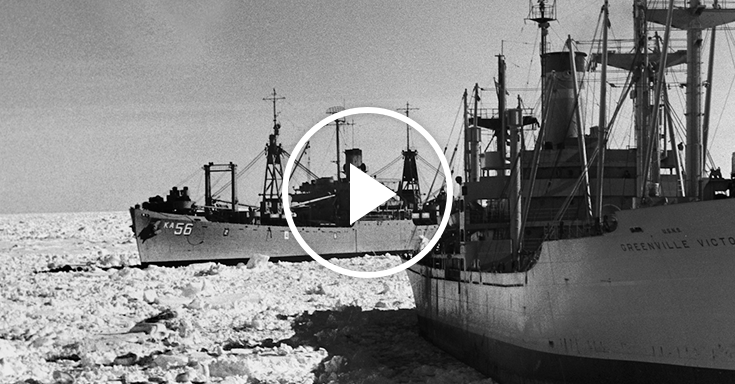
We did it!/We’re here! Chang and I are the first New York Times journalists to reach the Thwaites Glacier, but the Times has a long history of Antarctica reporting. Chang and I have made it to Thwaites! We’re the first New Yo rk Times reporters to make it! It feels like a good opportunity to look back at Times reporters who came before me and reported from Antarctica. Chang and I have made it to the Thwaites – the first New York TImes journalists to reach the glacier. But the Times has a long history of Antarctica reporting. Before I left I dug into the archives. Before the trip I dug into the archives Before leaving I dug into the archives. These pages represent 100 years of the New York Times in Antarctica. The first New York Times reporter to report from Antarctica was Russell Owen, who joined a US Navy commander, Richard Byrd, for 14 months between 1928 and 1930. And the Times called him the world’s first polar reporter. The Times didn’t have a photographer on the Byrd expedition, but a documentary film did capture the exploration Owen was the only reporter there. So it was an exclusive, a 14 month exclusive. His dispatches are still so vivid today. “Byrd mushes over the ice barrier.” And this story’s about Commander Byrd leaping into the water to save one of his men. There’s a lot of action here. I think certainly at the beginning of the 20th century, it was just still this remote, unknown, inhospitable, uninhabitable place. A place that humans hadn’t conquered and developed in the same way.. That was the story that the New York Times was reporting on back then. And then, of course, over the decades that changed. 00:48:21:02 – 00:48:33:11 In the 1950s and 60s, the New York Times science reporter Walter Sullivan also took several trips to Antarctica, bringing back a number of his own photos from the trip, as well. 00:51:58:20 – 00:52:27:11 So this is one of Walter Sullivan’s stories from 1955 from Antarctica. And we already see a lot of attention to scientists at work. They’re taking cores of sediment from the seafloor. Malcolm Brown was another New York Times science reporter who made a number of trips to Antarctica in the last decades of the 20th century. The caption on this Malcolm Brown story from 1974 is “Studies are in progress to determine whether the Antarctic ice cap is deteriorating.” So that’s half a century ago, this was already top of mind for scientists in Antarctica. So the first scientists to really focus specifically on Thwaites and the glaciers around it published papers in the late 70s. They called it the potential “weak underbelly” of the Antarctic ice sheet. Antarctica’s melting ice is already raising global sea levels. And if global warming isn’t stopped, it will continue doing so for centuries to come And yet Now we have the tools. We have the capabilities to really not just understand this threat, but maybe even get ahead of it. OUTRO 1: That’s what this trip is about – these scientists are trying to study the Thwaites ice from all angles – including underneath – to see what mitigation efforts might help TKTK The hope on this expedition is do just that – to find ways to mitigate the threat TKTKTK The scientists on this expedition want to do just that. And tktk.
By Raymond Zhong, Kassie Bracken, Christina Thornell, David Seekamp, Stephanie Swart, Phil Caller, Chang W. Lee and Nikolay Nikolov
January 18, 2026